9,000 Hectares of Poppies Found in Balochistan as Afghan Ban Pushes Cultivation Across Borders
Satellite data and farmer interviews reveal a massive expansion of poppy fields in Pakistan’s poorest province, driven by Afghan growers seeking stable land after the Taliban’s narcotics ban.
By Jisoo Vega ·
Satellite imagery reveals a vast new zone of opium production stretching across Pakistan’s southwestern border.
Analysis by the British firm Alcis, detailed in an August report by David Mansfield, identifies more than 9,000 hectares of poppy cultivation in Balochistan Province alone. This area represents a substantial portion of the global supply chain, with the majority of fields concentrated in the districts of Loralai and Killa Abdullah. Mansfield, author of A State Built On Sand: How Opium Undermined Afghanistan, describes the tri-border region involving Afghanistan, Pakistan, and Iran as having become a global center for opium production. The expansion follows the Taliban’s 2022 ban on illicit narcotics, which sharply reduced output inside Afghanistan but did not eliminate it entirely.
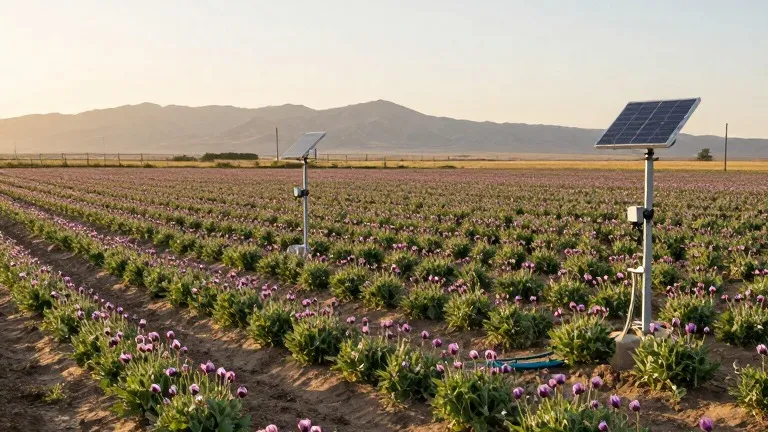
The shift in production has been fueled by Afghan farmers crossing into Balochistan to lease land. These growers bring capital and agricultural expertise, investing millions of Pakistani rupees in infrastructure such as solar-powered wells. They share the resulting profits with local landowners, creating a stable economic arrangement that has attracted new entrants to the crop. In 2026, many farmers doubled their cultivated land, a trend Mansfield identifies as a strong indicator that cultivation levels will rise further in 2027.
Local officials and residents describe a complex mix of economic necessity and political protection. Abdul Qahar Wadan, a former National Assembly member from Killa Abdullah, states that cultivation is rampant and backed by senior military officials and pro-government power brokers who take commissions. Monawar Hussain, the district’s chief administrative officer, disputes this, citing a decline in cultivation following an eradication campaign last year. However, Alcis imagery from 2026 shows no clear evidence of such eradication, suggesting the official narrative does not match the visual record.
For many smallholders, the poppy crop offers a reliable alternative to traditional farming, which has been devastated by insecurity, drought, and flash floods. Lala Jan Kakar, a resident of Killa Abdullah, notes that the demand for poppies far exceeds that for fruits, and the income is higher. An anonymous farmer in the district reported that growers pay bribes to local authorities through intermediaries. He alleged that when media attention pressures local officials, growers sometimes plant poppies on barren land specifically so authorities can destroy the crop and publicize the effort.
A similar pattern has emerged in Iran’s Sistan-Baluchistan Province, where Afghan farmers work as tenants and sharecroppers. Satellite imagery from 2026 shows extensive poppy fields in the region, some equipped with drip irrigation. This costly infrastructure suggests that growers who planted in late 2025 expected little risk of eradication. Iranian authorities, distracted by their conflict with the United States and Israel since late February, have been unable or unwilling to destroy the 2026 crop. Experts expect cultivation to increase in 2027 as the regional economy weakens and separatist insurgency intensifies.
Inside Afghanistan, opium production is rebounding despite the ban. Cultivation is concentrated in northeastern Badakhshan Province, which accounts for roughly half of national output, and in several southwestern provinces. Mansfield noted that southwestern cultivation almost doubled between 2025 and 2026. Farmers in these areas have defied the ban under forceful enforcement, driven by drought and debt. A recent Taliban directive barring home searches for poppy or opium without a court order is seen as a concession to limit unrest.
The United Nations Office on Drugs and Crime has estimated that opium production in Pakistan remains marginal, though it acknowledged that scarce regional data and sharp rises in eradication figures point toward spillover effects. Pakistan’s Interior Ministry and the provincial government did not respond to requests for comment. Mansfield warned that if Afghan farmers interpret the recent concessions as a signal of tolerance, the country could see a dramatic rise in opium production in 2027. The expansion of drug production also fuels regional violence, as armed groups compete for tax revenues from the trade and other cross-border activities.
Source: RFE/RL