Karak Church Shooting Kills Eight as Jordan Tracks Down Trio of Suspects
A rare terrorist assault on a Greek Orthodox funeral in southern Jordan has triggered a national manhunt and a review of security protocols.
By Yasmin Kovalenko ·
Jordan’s religious landscape has long been defined by close proximity between its Muslim majority and its smaller Christian minority, a dynamic that faced a sudden and violent test this week. Security officials are currently scouring the Karak governorate for three unidentified men who launched a deadly assault on a place of worship on Friday afternoon, an event that has shaken the nation and prompted immediate high-level governmental responses.
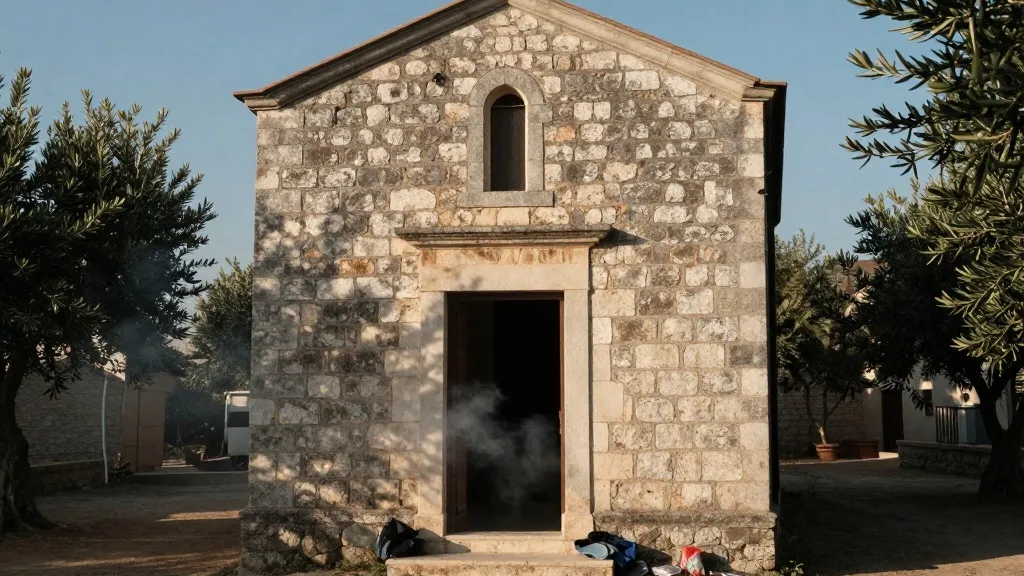
The incident occurred during a funeral service at a Greek Orthodox church in the village of Hamoud. Witnesses described a sudden explosion as the ceremony began, followed by the arrival of two attackers in a vehicle. A third individual, armed with a semi-automatic rifle, joined them as they entered the building. The gunmen fired for several minutes before retreating, leaving eight people dead and dozens more injured. The Ministry of Health confirmed that seven victims died at the scene, while an eighth woman succumbed to her wounds several hours later in a hospital bed.
Survivors provided harrowing accounts of the close-range violence. Nasser al-Burqan, a lawyer who escaped with his life, recounted how one gunman fired a handgun from a distance of only two meters. His son, who was also present, sustained a leg wound and is currently receiving medical care. Tarek Ammarin, who was visiting a relative injured in the blast, characterized the event as a massacre in every sense of the word. According to Petra news agency, 40 individuals were treated for injuries, with 27 still hospitalized. One patient at Prince Ali Military Hospital remains in critical condition following surgery.
In response to the violence, King Abdullah II expressed his condolences to the bereaved families and vowed that the perpetrators would face the harshest penalties. He also directed a comprehensive review of the kingdom’s security procedures for managing future terrorist incidents. Prime Minister Jafar Hassan labeled the attack a manifestation of blind extremism and declared three days of national mourning, resulting in flags flying at half-mast across public buildings. Interior Minister Mazin Al-Farrayeh attributed the violence to a group of extremists, though no specific organization has been named.
State broadcast footage shows the three suspects firing on a group of men attempting to flee outside the church. Despite the circulating video evidence, the government continues to refer to the suspects as unknown assailants, and the precise motive remains under investigation. The Karak region, located roughly 120 kilometers south of Amman, is home to a significant portion of the country’s approximately 300,000 Christians.
International reactions have poured in from nations including Iraq, Qatar, Poland, Azerbaijan, and Palestine. The United States embassy extended its sympathies to the victims, while Ahmed al-Tayeb, the grand imam of Cairo’s Al-Azhar, described the shooting as a heinous terrorist act. Experts note that while such attacks are rare in Jordan, the area has experienced violence before, including a 2016 siege on a historic castle by ISIL fighters that claimed ten lives.
Community leaders emphasize that the attack may strengthen local bonds rather than divide them. Taylor Luck, a senior correspondent for the Christian Science Monitor, highlighted the pride Jordan’s Christians take in their long history of interfaith coexistence with neighbors in Karak. This enduring solidarity suggests that the community may emerge from the tragedy with a renewed sense of unity.
Source: Al Jazeera