El Niño rains trap thousands in Four Corners as Election Day approaches
Record rainfall forces evacuations in Colorado, Arizona, and New Mexico, while officials scramble to arrange voting for stranded residents.
By Lucas Murphy ·
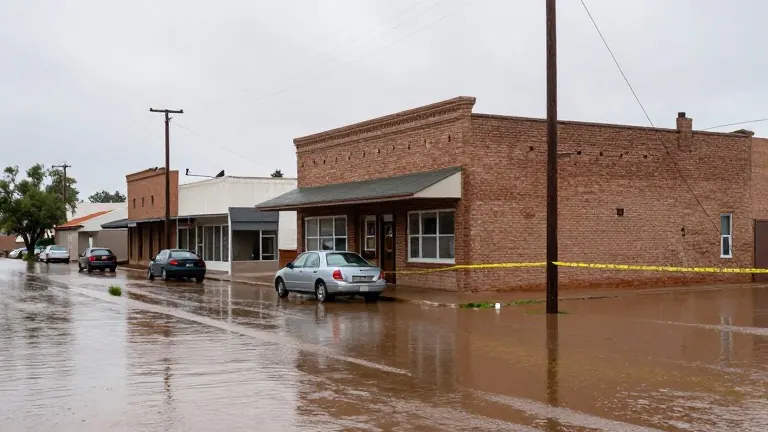
The Four Corners region, where New Mexico, Arizona, Colorado, and Utah intersect, typically experiences arid conditions, yet it is currently absorbing an unprecedented volume of water. On Monday, intense rainfall triggered widespread flooding that forced hundreds of residents to evacuate and kept swift-water rescue teams operating continuously across the states.
Former National Oceanic and Atmospheric Administration chief scientist Ryan Maue calculated that more than 20 trillion gallons of rain fell on the Four Corners states and Nevada over the previous two weeks. The National Weather Service attributed the disruption to El Niño, a phenomenon driven by warming Pacific waters. Officials in Pagosa Springs, Colorado, had warned of potentially catastrophic flooding in the town of roughly 2,000 residents. The San Juan River reached 16.81 feet late Sunday night, flooding downtown streets before receding on Monday. This level is close to the 17.8 feet recorded during the 1911 disaster that nearly destroyed the town.
In Durango, Colorado, police Chief Brice Current reported that many residents remained stranded along the Animas River. The river was closed to recreational watercraft, and officials warned that sewage and chemicals in the water posed health risks. Greg Ewing, a local volunteer, described the community response while helping clear mud from yards. He noted that neighbors came together to dig out debris, a common practice in the area.
Arizona recorded its wettest November 1 in history. Workman Creek near Phoenix received 7.3 inches of rain over two days. In Flagstaff, 5.15 inches of rain contributed to the record total. Meteorologist Jennifer Tate with the NWS Weather Prediction Center stated that the system was broad rather than localized. Two deaths were reported in the state. Williams Singavarapu, 73, was found in a drainage area in Flagstaff 15 blocks from where he disappeared. A second unidentified man was found dead in a drainage area, with police indicating the death appeared weather-related.
In New Mexico, evacuations were ordered along the San Juan River and in the village of Chama. The river was expected to continue rising through Wednesday. In southern Utah, Ryan Benally, a professor at Utah State University, built dirt berms to protect his parents’ home near Montezuma Creek. He reported that families in remote areas were becoming difficult to reach as emergency access routes washed out. Benally coordinated deliveries of water, boots, and toiletries to shelters.
Election Day logistics were altered in Colorado due to the flooding. The Secretary of State’s office stated that residents of Pagosa Springs who received mail ballots could obtain replacements at any vote center. Voters could return mail ballots to any drop box in the state by 7 p.m. on Election Day. In-person ballots cast outside the home county could only be used for statewide races. Deanna Chiappetta, a resident of the Aspen Springs subdivision, said her neighborhood was isolated because bridges were impassable. She noted that campers were washed away and the foundation of a local museum was damaged. Highway 160 remained closed, limiting supply access to the town.
Officials in Sedona, Arizona, ordered evacuations for residents near Oak Creek after floodwaters trapped several people in their homes. Rain washed out part of a main highway between Flagstaff and Sedona, damaging guard rails and scattering boulders. In Tucson, meteorologist Aaron Hardin noted that the area was receiving two or three months of rain in a few days. In the Pinetop-Lakeside area, manhole covers popped up, and the sanitary district announced that sewage backed up into homes.
Source: WTOP News