First Simulation Captures Mars' Elusive Morning Cloud
Sorbonne researchers say a rare freezing process explains the 1,000-mile feature.
By Jisoo Vega ·
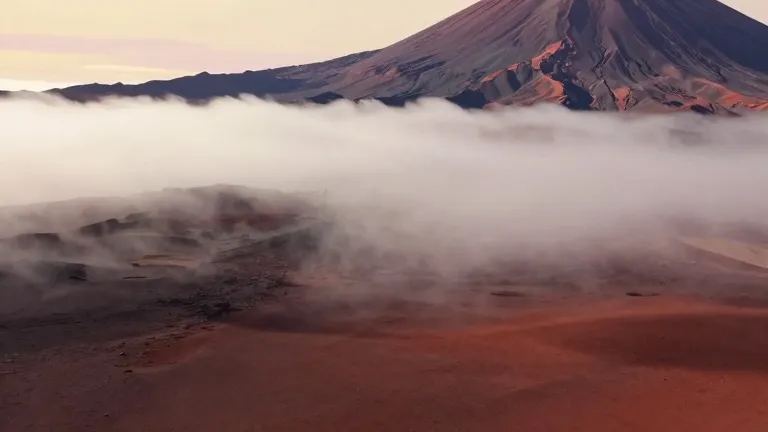
Jorge Hernández-Bernal and colleagues at Sorbonne Université in Paris developed a computer model that successfully replicates the formation of the Arsia Mons Elongated Cloud. The team published their findings in Nature Geoscience. This work marks the first time scientists have reproduced the cloud's development in a simulation.
The cloud stretches more than 1,000 miles near the Martian volcano Arsia Mons. It appears each morning during Martian spring and summer. The feature grows throughout the morning until it reaches a length comparable to the distance from New York to Kansas City. It then dissipates before the cycle repeats over several months.
Hernández-Bernal stated that the simulations only worked after the researchers included what he called "exotic physics." He described this process as homogeneous nucleation, where water vapor turns directly into ice crystals without dust or salt particles to seed the formation. He compared the phenomenon to condensation appearing in the middle of a room rather than on a window.
The model requires extreme atmospheric conditions to trigger this process. Specifically, the air must cool by 30 degrees Celsius within 10 minutes. The wind interaction with the 65,000-foot volcano generates a wave that lifts moist air high into the atmosphere. This mechanism creates the necessary humidity levels for the cloud to form.
The humidity required for homogeneous nucleation is more than 100,000 times greater than any value measured on Earth. Scientists had not previously confirmed that such humidity levels existed on Mars. Hernández-Bernal noted that this discovery challenges previous assumptions about the Martian atmosphere.
The cloud was first recorded by a probe in 2018. Researchers had struggled to explain its existence for nearly four years. Hernández-Bernal said the physics involved appears in textbooks but is usually considered theoretical. He added that the result is remarkable because far less is known about the Martian atmosphere than Earth's.
Source: Wired