Ukraine Confirms Full Restoration of Starlink Bandwidth for Military Operations
After a period of speed caps that hampered drone logistics, Kyiv announced that satellite internet speeds have returned to full capacity following diplomatic tensions with Washington.
By Yasmin Kovalenko ·
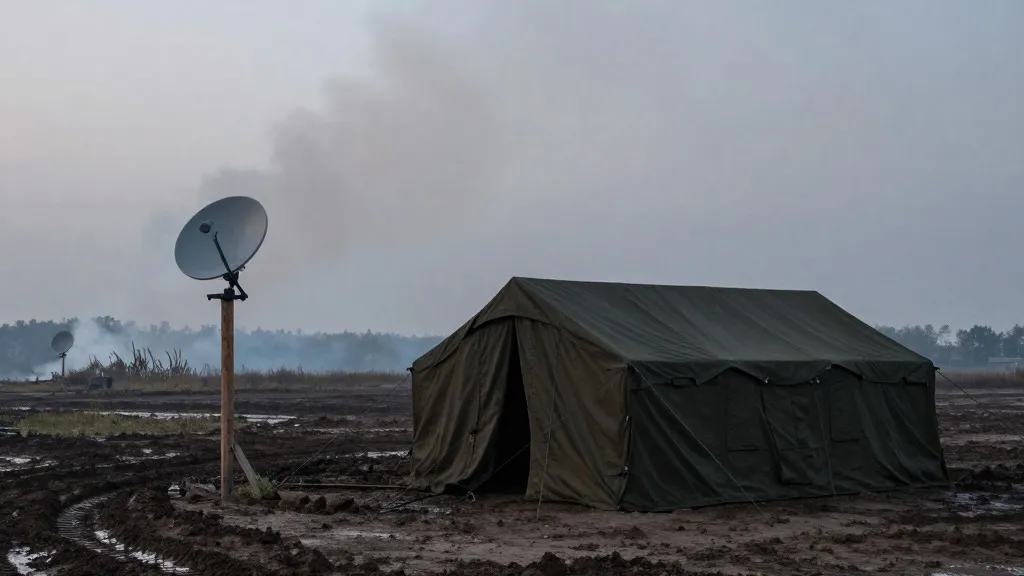
The satellite internet infrastructure that supports Ukraine’s modern warfare capabilities has returned to full operational status, ending a brief period of technical friction with Washington. The resolution comes at a critical moment for the front line, where connectivity is as vital as ammunition.
Defence Minister Yevhenii Khmara confirmed on Saturday that the network is stable and unrestricted. He noted that connection speeds have recovered to more than 400km/h, a metric that signals the return of full capability. Khmara emphasized that this restoration is crucial for the soldiers at the front, the operation of drones, and the broader logistics and communication networks that sustain the military effort.
The recent disruption forced Ukrainian forces to adapt to lower speed thresholds. Under the temporary limits, drones reportedly lost their connection when traveling at 161km/h or faster. This restriction complicated operations that rely on real-time data transmission. The military now operates with the full bandwidth of the system, allowing for the high-speed data exchange required by advanced autonomous vehicles.
The controversy began last week when Ukrainian officials alleged that President Donald Trump instructed Elon Musk to impose these limits. Trump initially denied giving such an order but later acknowledged that Musk had resolved the issue. The dispute coincided with a wider diplomatic disagreement over Ukraine’s strikes on Russian oil infrastructure. With midterm elections approaching next month, the timing of the technical restrictions raised questions about the political dynamics at play.
Ukraine relies heavily on the network of 10,000 low Earth orbit satellites to conduct operations, particularly in remote areas of the battlefield. The military utilizes both the civilian Starlink service and the more secure Starshield system. Musk has indicated that the US military controls Starshield, suggesting that the Pentagon may have been involved in the recent connectivity issues. The stability of these links is essential for coordinating long-range attacks and managing battlefield logistics.
The network has a specific operational blind spot, as Russia is not authorized to use Starlink. Consequently, the connection does not function when Ukraine launches long-range missiles or drones deep into Russian territory, such as when targeting oil refineries. This limitation has been a point of contention, especially given the global impact of those strikes on fuel prices. While this year’s price increases are largely attributed to the Iran war, the Russian refinery attacks have also contributed to market volatility.
The diplomatic row between Trump and President Volodymyr Zelensky centered on the effectiveness of Ukrainian strikes on Russian oil infrastructure. Trump argued that these attacks pushed global prices higher, while Kyiv maintained that they were necessary to cut off a primary source of revenue for Moscow’s war effort. Zelensky also claimed that the US threatened to withdraw intelligence sharing if the strikes continued, a threat Trump also denied. The restoration of Starlink speeds occurs against this backdrop of shifting alliances and economic pressures.
Ground fighting continued amidst these developments. Russia’s defence ministry reported on Saturday that its air defenses shot down 616 Ukrainian fixed-wing drones across several regions, including the Russian-annexed Crimea. Sergey Aksyonov, the Moscow-backed governor of Crimea, stated that restrictions on electricity and water were introduced following power cuts caused by the drone strikes. The attacks highlighted the continued intensity of the conflict in the southern regions.
Ukrainian authorities detailed their own offensive actions over the past 24 hours. They reported striking a missile component manufacturer, a chemical plant, and an aircraft at a military airfield within Russia. In response to these actions, Kyiv said Russia carried out 88 air strikes on Friday. These strikes utilized 309 glide bombs and a significant volume of 10,270 kamikaze drones, underscoring the scale of the aerial engagement on both sides.
Source: BBC News