37 Million Tons: The Heavy Reality of Russia's Arctic Ambitions
Record cargo volumes on the Northern Sea Route are marred by ice traps, sanctions, and questions about long-term reliability for global trade.
By Jisoo Vega ·
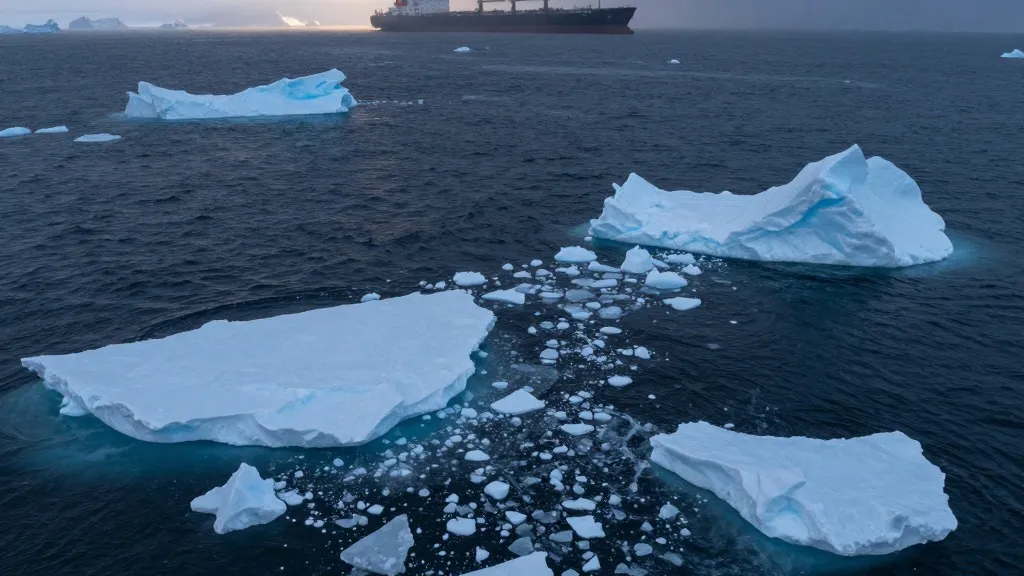
A fleet of sanctioned Russian tankers sat trapped in the freezing grip of the Vilkitsky Strait this past July.
The vessels were anchored far above the Arctic Circle, stuck in ice within a narrow 55 kilometer corridor between the northern Siberian coast and Bolshevik Island. This specific location serves as a critical choke point on the Northern Sea Route, the primary waterway Russia uses to transport energy to China. At the time of the blockage, assistance from two nuclear-powered icebreakers was days away, a significant distance in such a remote region.
Only one tanker managed to break through the ice. The remaining vessels waited for up to two weeks for the heavy ships to arrive. Despite the aid, the fleet could not navigate the strait and was forced to reroute entirely. This incident highlights a significant gap between the Kremlin’s promotional narrative and the physical reality of the Arctic.
Russian leaders have long championed this route as a strategic alternative that avoids Ukrainian drone strikes and potential European naval interception of shadow fleet vessels. President Vladimir Putin described the waterway as a reliable and safe path to the world's largest markets. At the launch of the Vostok Oil project on the Taimyr Peninsula last month, he stated that 37 million tons of cargo moved along the route in 2025, though not the full length. He predicted this volume would almost double by 2030, a goal that contrasts with a 2019 target of 80 million tons by 2024.
Independent data paints a more modest picture of the route's current utility. The Norway-funded Center for High North Logistics reported that Russia shipped about 2 million tons of crude oil, roughly 15 million barrels, along the entire route to Asian destinations by the end of September. Most of this cargo originated from Murmansk. By mid-October, traders and shipping data indicated the total had reached approximately 20 million barrels. While this represents a 50 percent rise over 2025 figures, it still accounts for only about 1 percent of Russia's total seaborne oil exports.
Tomas Alexa, a senior analyst at the maritime security consultancy Ambrey, characterized this increase as a surge from a relatively low base. He noted that Western sanctions continue to hinder Russia's ability to build and maintain Arctic-capable vessels. Spare parts and construction materials often require complex routing through third parties, and repair services previously provided by Norwegian, Danish, and Dutch firms are no longer readily available.
Other nations are beginning to test the waters as well. South Korea reported on October 22 that its first container ship had completed a transit of the route. Officials in Seoul praised the journey as a shortcut to Europe but acknowledged the challenging conditions, including large ice floes in the Bering and Vilkitsky straits. China also operated a scheduled container service to Europe for the first time this year, completing several successful voyages.
Catherine Sendak of the Center for European Policy Analysis noted that Russia views much of the Arctic as an inner waterway. She raised questions about potential tolls and the specific services Moscow might offer to commercial vessels, suggesting that good answers are not yet in place. There is also uncertainty about whether Russia might limit access for other actors in the future.
Security concerns in the region are intensifying as geopolitical stakes rise. EU foreign affairs chief Kaja Kallas stated on October 21 that the region has become a front line of global power competition. This assessment comes as NATO launched its Arctic Sentry mission in February and the United States announced plans last month to expand its military presence in Greenland.
Environmental groups are watching the increasing traffic with concern, particularly regarding aging shadow fleet tankers. Ksenia Vakhrusheva, head of the Arctic project at the Lithuania-based group Bellona, explained that melting ice can break up and pack tightly in narrow straits, blocking ships that lack an ice class. She warned that oil degrades more slowly in cold conditions and can spread over ice, potentially accelerating climate change effects. Furthermore, Russia publishes no information on incidents along the route, and the area's remoteness means no independent group can easily report on them.
Source: RFE/RL
More Business · World news · Bad Business · Report a business · Got a Story?