Terafab Ambition: Musk Targets 1 Terawatt AI Chip Output by 2028
The joint Tesla and SpaceX venture aims to build a vertically integrated facility in Texas capable of producing one terawatt of computing power annually, with suppliers rushing to meet aggressive delivery deadlines.
By Yasmin Kovalenko ·
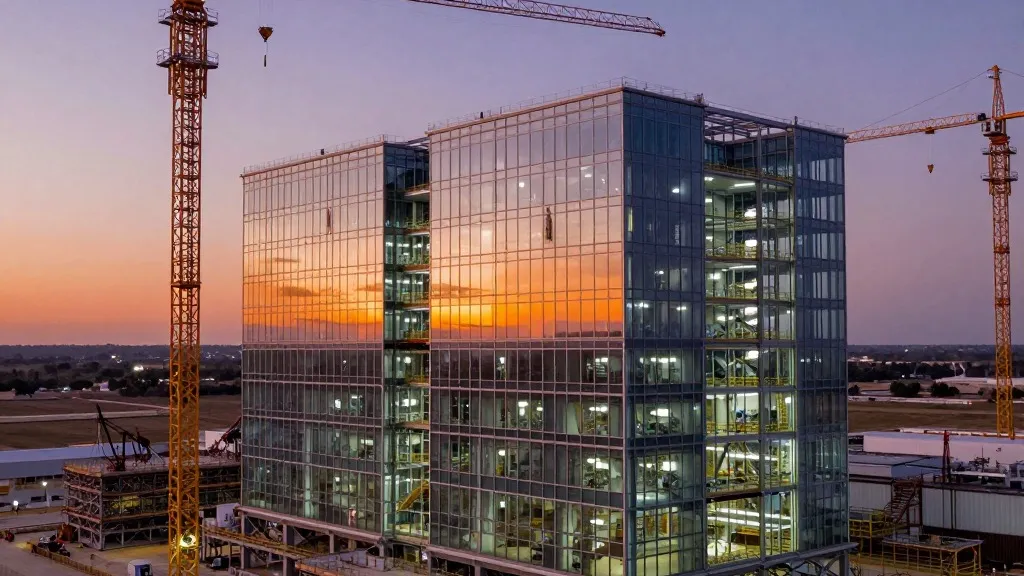
One terawatt. That is the staggering annual output target for Terafab, the massive semiconductor manufacturing project jointly developed by Tesla and SpaceX. To put that figure in perspective, it represents a single facility’s production capacity that dwarfs the current global landscape of AI-optimized data centers. Elon Musk, the chief executive of both parent companies, outlined this ambitious vision during a live broadcast on X on October 20, 2026. He stated that the facility, located in Gibbons Creek, Texas, is on track to begin volume chip production by the third or fourth quarter of 2028. While Musk acknowledged that the timeline is "highly aspirational" and carries significant uncertainty, he emphasized that the project’s commercial value could eventually rival the GDP of a top-20 global economy, with Switzerland currently holding the 20th spot at approximately $1.14 trillion.
The path to this industrial giant began with strategic partnerships and rapid technological adoption. In April 2026, Intel officially joined the Terafab venture. This collaboration allows the project to utilize Intel’s 14A manufacturing node technology, a critical step for high-density logic and memory fabrication. The project is designed as a vertically integrated factory, meaning it will handle logic, memory, and advanced packaging under one roof. This integrated approach is intended to mitigate future shortfalls of cutting-edge AI processors from external foundries like TSMC. The chips produced here are slated to power Musk’s xAI clusters, self-driving vehicles, Optimus humanoid robots, and SpaceX’s orbital AI data center.
To achieve the 2028 target, the supply chain has been pushed into overdrive. Musk announced that key suppliers, including ASML, are expediting shipments of critical equipment. ASML, the world’s sole commercial supplier of extreme ultraviolet (EUV) lithography systems, is perhaps the most vital partner. Each of these systems costs around $400 million and is essential for leading-edge chip production. Unofficial reports suggest that the first EUV tool for Terafab was originally slated for delivery in mid-2027. It remains unclear if this date reflects the accelerated schedule Musk described, but the urgency is palpable across the supplier network.
Beyond lithography, a broad coalition of equipment manufacturers is involved in the build-out. American firms such as Applied Materials, Lam Research, and KLA Corporation are providing front-end processing, metrology, and process control machinery. Japan’s Tokyo Electron is also a key contributor. The project is further engaging with approximately ten South Korean equipment makers, including Hanmi Semiconductor for advanced packaging and HPSP for high-pressure hydrogen annealing. These collaborations are necessary because capacity remains tight across the global semiconductor supply chain, making the expediting of orders a critical factor in meeting the aggressive timeline.
The announcement also highlighted broader ambitions for Musk’s AI infrastructure. He expects his AI companies to have 2.5 to 3 gigawatts of computing capacity active by the end of 2026. By the end of 2027, he aims to bring an additional 10 gigawatts online, bringing the total to 13 gigawatts. To support this growth, SpaceX and xAI are aggressively procuring next-generation NVIDIA hardware. Specifically, plans are in place to get a 440,000-GPU Nvidia "Vera Rubin" training cluster operational by the end of the second quarter of 2027. This massive cluster will serve as a backbone for the AI workloads that Terafab’s chips are designed to accelerate.
However, the sheer scale of the Terafab goal has drawn scrutiny from industry experts. Research firm Gartner estimates that the total global AI-optimized data center capacity is roughly 44 gigawatts as of late 2026. This means Terafab’s planned annual output of one terawatt is approximately 22.7 times the current global capacity. While global AI computing capacity has grown at a rate of 3.3 to 3.4 times per year since 2022, according to EpochAI, the jump required to reach one terawatt annually is monumental. The project’s success will depend on whether the supply chain can sustain the pace of delivery and whether the manufacturing yield can meet the demands of such a high-volume operation.
The facility’s first experimental test chip is expected to be manufactured at SpaceX’s research fabrication facility in Austin, Texas, around the second quarter of 2027. This initial step is a crucial proof of concept before the full-scale production begins in Gibbons Creek. If successful, Terafab will not only serve Musk’s ecosystem but also supply the broader AI industry, potentially reshaping the global balance of semiconductor manufacturing. The project represents a multi-billion-dollar investment in domestic production, aiming to consolidate the complex supply chain into a single, highly efficient physical location.
As the project moves forward, the focus remains on execution. The collaboration with Intel provides the foundational process technology, while the network of global suppliers ensures the physical machinery is in place. The timeline is tight, and the margins for error are small, as Musk himself noted. The coming months will be critical as the first EUV tools arrive and the Austin test chip is completed. For the semiconductor industry, Terafab is not just a factory; it is a bold assertion that a single entity can dominate the future of AI hardware production.
Source: Tom's Hardware · original report published
More Business · Bad Business · Report a business · Got a Story?