Three Heavy Rockets Set For Artemis III Lander Trials
NASA's plan calls for launching Blue Origin's New Glenn, the Space Launch System, and SpaceX's Starship in sequence over two weeks.
By Lucas Murphy ·
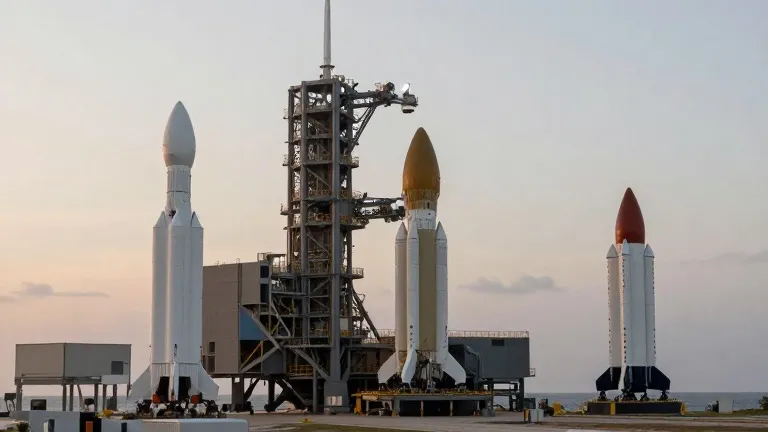
NASA outlined an October 23 flight plan for Artemis III that requires launching three heavy rockets from Florida's Space Coast to test commercial moon landers before a crewed landing attempt.
Artemis program manager Jeremy Parsons described the effort as involving "three of the most powerful rockets in the world" and likely "the most complicated launch campaign ever undertaken." The briefing at Kennedy Space Center ran more than two hours.
The sequence starts with Blue Origin's New Glenn carrying the Blue Moon lander into low Earth orbit. NASA's Space Launch System follows, lifting the Orion capsule and four astronauts: NASA's Randy Bresnik, Andre Douglas, and Frank Rubio, plus the European Space Agency's Luca Parmitano. SLS will place Orion in an elliptical orbit ranging from 18 to 1,122 miles in altitude before the capsule raises itself to about 345 miles, a move Parsons attributed to thermal stability requirements.
Orion's crew will spend two days checking capsule systems before meeting Blue Moon on Flight Day 3 at 273 miles. The two vehicles stay docked for two days while astronauts enter the lander to evaluate its environmental controls and life support, confirm atmospheric pressure retention, and run emergency scenario and dual-vehicle control tests. Mission Control also goes through evaluations during this window.
Around Flight Day 6, SpaceX's Starship is expected to launch with a custom docking adapter on its nose. The 171-foot upper stage meets Orion on Flight Day 8 at about 237 miles. That contact lasts roughly two hours, and the crew stays inside Orion, gathering data on docking forces and how the vehicles interact.
After undocking from Starship, the mission runs another six to nine days before a parachute-assisted ocean splashdown. The planned duration is 14 days and could stretch to 17. Crew tasks include evaluating survival suits, a step skipped during the 10-day Artemis II lunar flyby in April, plus health assessments, experiments, and technology demonstrations.
The flight is designed to prepare for Artemis IV, scheduled to land astronauts near the moon's south pole in 2028. That would mark the first crewed lunar landing since Apollo 17 in 1972. NASA Administrator Jared Isaacman said the agency has not picked which lander will fly that mission, saying, "We have no intention of surrendering a viable path to the surface before the data and schedule compels us to do so." Parsons said both providers are planning lunar landing missions in 2028; Blue Origin's profile has Orion meeting the lander in lunar orbit, while SpaceX's plan has Starship docking with the capsule in Earth orbit and pushing toward the moon.
A launch date for Artemis III is not set. NASA is targeting summer 2027, though Isaacman told employees in a memo last month the mission is running about 90 days behind schedule. Parsons named the lunar lander supply chain as a major challenge. Isaacman said, "We're moving with real speed and purpose right now."
Isaacman's memo and Parsons' comments on supply chain issues came as both officials expressed confidence in resolving schedule problems. The briefing took place October 23 at Kennedy Space Center in Florida.
Source: Space.com