Democrats Retake House, Flip Four Senate Seats, and Oust Trump-Backed Candidates
A wave of blue wins in key states like Texas and South Carolina suggests a major shift in voter alignment, while Republican losses mount in races hand-picked by the president.
By Lucas Murphy ·
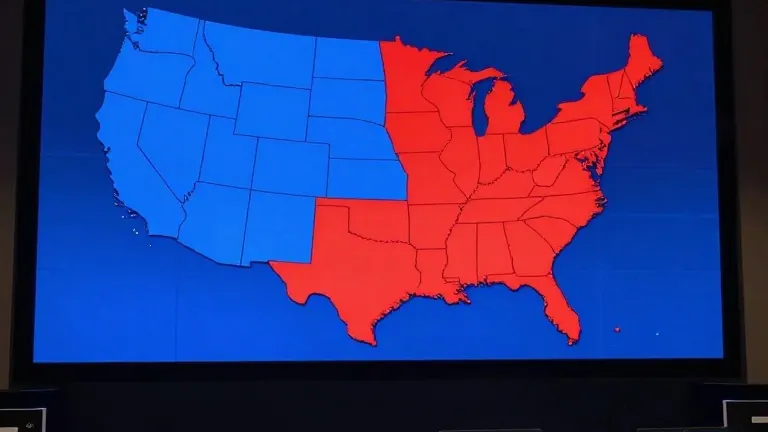
Democratic candidates seized control of the House and captured four Senate seats on Tuesday, effectively rejecting Donald Trump’s influence in the midterms. The results show a sharp reversal in political momentum across the country. Republicans, who held both chambers, now face a fragmented map with key losses in states they previously dominated.
The shift is visible in the numbers. In rural Middle America, the large margins Trump secured in 2024 have shrunk considerably. In congressional districts with high Latino populations, the president’s recent gains have largely disappeared. This swing has given Democrats a path to retake the Senate if they hold their own seats in Michigan and Minnesota or take more seats in competitive races in Alaska, Iowa, Kansas, and Maine.
The timeline of this political realignment began with redistricting and presidential endorsements that were meant to secure Republican wins. Trump spent the last month campaigning heavily, often choosing candidates over more established party members. That strategy backfired in several states. In North Carolina, Georgia, Texas, and South Carolina, candidates Trump backed either lost or are trailing. In Florida, Democrats won several districts that mapmakers had redrawn to ensure Republican victories.
Specific Senate races marked the turning point. In Texas, state representative James Talarico defeated Ken Paxton, a scandal-plagued state attorney general endorsed by Trump. This became the most expensive Senate race in U.S. history. In Ohio, Sherrod Brown beat Senator Jon Husted, completing a political comeback two years after losing his own seat. Former Governor Roy Cooper won in North Carolina against Michael Whatley, a result strategists expected.
South Carolina produced the most surprising result. Democrat Annie Andrews defeated Darline Graham, the sister of the late Senator Lindsey Graham. This is the first time a Democrat has won a Senate race in the state since 1998. Graham, a political novice, was pressured by Trump to run for a full term after temporarily filling the seat. She struggled during debates and on the campaign trail, leading to her loss.
In Florida, the Latino voter shift was stark. In the 27th District in Miami-Dade County, Republican Representative Maria Elvira Salazar leads Democratic challenger Eliott Rodriguez by only a few thousand votes. Two years ago, Salazar won by 20 percentage points. That margin has now nearly vanished. In other Florida districts, Democrats Kathy Castor, Jared Moskowitz, and Pia Dandiya are projected to win seats that Republicans had redrawn to guarantee their own victories.
The White House reaction was tense. Trump watched returns from the East Room and remained silent on social media for three hours before posting a message. He stated, “I wasn’t on the Ballot and if I was, we would have won IN A LANDSLIDE!” He had previously told supporters to treat the election as if he were on the ballot. His recent campaign blitz, which he described as exhausting, aimed to secure Republican majorities but left the party with weak candidates in key races.
The results also signal strength for potential 2028 presidential candidates. Governors JB Pritzker and Josh Shapiro both won reelection in Illinois and Pennsylvania. Pritzker said in his victory speech, “We climbed one mountain tonight, but we are sitting at the base of another.” In Kentucky, Democrat Zach Dembo flipped a House district in central Kentucky. In Georgia, Keisha Lance Bottoms is set to become the first Black female governor after defeating Republican candidate Mike Collins.
Millions of votes remain to be counted, but the direction of the results is clear. Democrats have already flipped the four Republican-held Senate seats needed to claim a majority. They now aim to hold their own seats in Michigan and Minnesota. The party also looks to win more seats in Alaska, Iowa, Kansas, and Maine. The losses for Republicans in Texas, North Carolina, and South Carolina forced national leaders to spend millions in races they did not expect to be close.
Source: CNN